· Peter De Witte · Background · 7 min read
Why Curtat is named after a 1948 calculator
Curtat is named after the Curta, a pocket calculator from 1948 and the least connected computer ever built. The company exists to do the opposite and make offline reality visible on the internet.
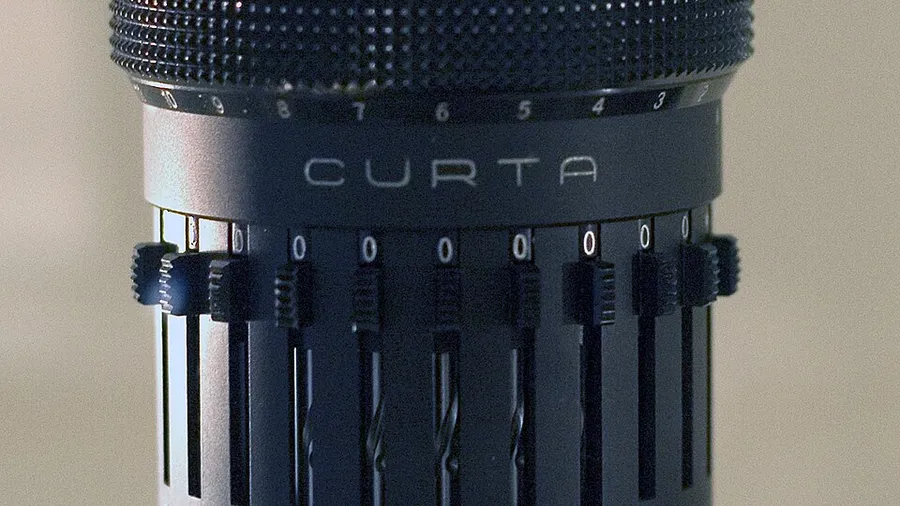
The name of this company is derived from the Curta, a pocket calculator. It was the least connected computer ever built: a complete machine, in your palm, with no battery, no firmware and no way in.
Curtat exists to do the opposite. The work is making reality visible on the internet through both technical and managerial services. That means offline devices, instrumentation, and equipment in basements and tunnels.
Hence the name: a contraction of that machine and an address. Curta + @. This is the long version.
The machine

Strictly speaking the Curta was not the first calculating device. Pascal built a working adder in 1642, and the abacus had a few thousand years’ head start. What it was, as Scientific American put it, is the first pocket calculator: the first machine that did all four operations, to eleven digits, and still disappeared into a coat pocket on the way out.
You set a number on the sliders down the side. One turn of the crank adds it. Pull the crank up a few millimetres first and the same turn subtracts instead. Multiplication and division are sequences of turns with the carriage shifted along. In other words, the Curta does not multiply for you so much as it refuses to let you make a mistake while you multiply.
The trick that made it small is Curt Herzstark’s complemented stepped drum, patented in August 1938. A calculator of the day needed around ten drums; he worked out how to do it with one, and how to subtract by adding the nines’ complement, which deleted the entire mechanical nightmare of borrowing. Everything else about the Curta follows from that single idea.
Drawn in Buchenwald
The unpleasant part of the story is the part that matters most, so it gets told straight.
Herzstark, the son of a Jewish father and a Catholic mother, was arrested in 1943 and sent to Buchenwald. The work-scheduling department there learned about his calculator and let him keep drawing it, on the understanding that a finished machine would be handed over “to the Führer as a present” if the war were won. In his 1987 oral history he said plainly what that offer meant to him: it was a way to extend his life, and he started drawing.
US troops liberated Buchenwald on 11 April 1945. By November he had found machinists near Weimar good enough to turn those drawings into three working prototypes. He then left for Austria and went looking for backers. Franz Joseph II, Prince of Liechtenstein, eventually put up the money, and a new company, Contina AG Mauren, started production in Liechtenstein.
So the smallest calculator in the world was designed twice: once before the war, in an office in Vienna, and once inside a concentration camp, by a prisoner who understood exactly why the drawings had to be good.
Two models, twenty-four years
| Type I (1948) | Type II (1954) | |
|---|---|---|
| Setting sliders | 8 | 11 |
| Revolution counter | 6 digits | 8 digits |
| Result counter | 11 digits | 15 digits |
| Weight | 230 g | 360 g |
| Price | $125 | $175 |
Around 140,000 were built before production stopped in 1972: roughly 80,000 Type I and 60,000 Type II. Thousands of them still work perfectly, which is a durability figure no product I have ever shipped is going to match.
Where it actually got used
Not in offices. The Curta’s best years were in rally cars and cockpits.
Rally crews used it through the 1960s, 1970s and into the 1980s for time-speed-distance work, long after electronic calculators existed, because the early electronic ones could not survive being bounced down a forest stage. Pilots used it for weight and balance, where being able to check your own arithmetic against the revolution counter matters more than being fast.
Both of those are the same requirement I get handed today: it has to work in a bad place, and you have to be able to trust the number. Ruggedised edge computing, several decades early, and nobody called it that either.
Bringing it online
The name started as a thought experiment I could not put down: what would it actually take to put a Curta on the internet?
Work down the list and it gets funnier. There is no power rail, because there is no power. There is no clock. There is no bus. The entire I/O subsystem is a thumb. The API is a crank, and it is strictly synchronous. One call, one turn, and the caller is a person leaning over a rally map at three in the morning. Latency is measured in wrist.
Then you reach the security review and realise you are looking at the most secure computer ever manufactured. Air-gapped by construction. Zero attack surface. No firmware, so nothing to sign and nothing to patch. The only remote exploit is asking somebody nicely to turn the handle for you. Uptime since 1948.
Its one documented failure mode is the owner. Contina got a steady trickle of Curtas returned in pieces by customers who managed the teardown and then discovered that putting one back together needs special jigs and intimate knowledge of which of several identical-looking parts goes where. The first hardware hackers, losing.
And that is the contradiction the company is named after. Every property that makes the Curta wonderful is a property you destroy the instant you give it an address. Its superpower is that it is not connected; my job is connecting things. Curta, plus @, equals a machine that has an address. It is also a joke I have now been explaining for years.
In practice the work turned out less absurd than the premise. What I actually do is the Curta’s trick applied to infrastructure: take something that has to keep working in a tunnel, under a platform, in a building with no signal, and make it legible from somewhere else, without pretending the hard part was ever the cloud.
The better name, which did not exist yet
In the interest of honesty: “Internet of Things” is the better name. It says in three words what everything above is circling: ordinary objects, doing their ordinary job, reachable over a network. If the phrase had been available I would have used something built on it and saved everyone the explanation.
It was not available. The term is generally credited to Kevin Ashton around 1999, and it took years after that to become something you could say to a client without drawing a diagram. By then the name was chosen and printed. So Curtat stays: a company named with the vocabulary that existed at the time, which is arguably the most IoT thing about it. Half the devices deployed in this industry are running a protocol somebody picked in 2004 and nobody can migrate off either.
Sources
- Curta on Wikipedia. The dates, weights and digit counts above come from here.
- Cliff Stoll, “The Curious History of the First Pocket Calculator”, Scientific American, January 2004.
- Curt Herzstark’s 1987 oral history interview with Erwin Tomash, held at the Charles Babbage Institute. It is the source for the Buchenwald account, in his own words.
- William Gibson put a Curta in Pattern Recognition (2003), which is how a lot of people who do not own a calculator from 1948 first heard of one.